Pioneering the Kenzan method — a robotic bioprinting technology that assembles living tissue constructs entirely from cells, without any artificial scaffolds. Saga University School of Medicine.
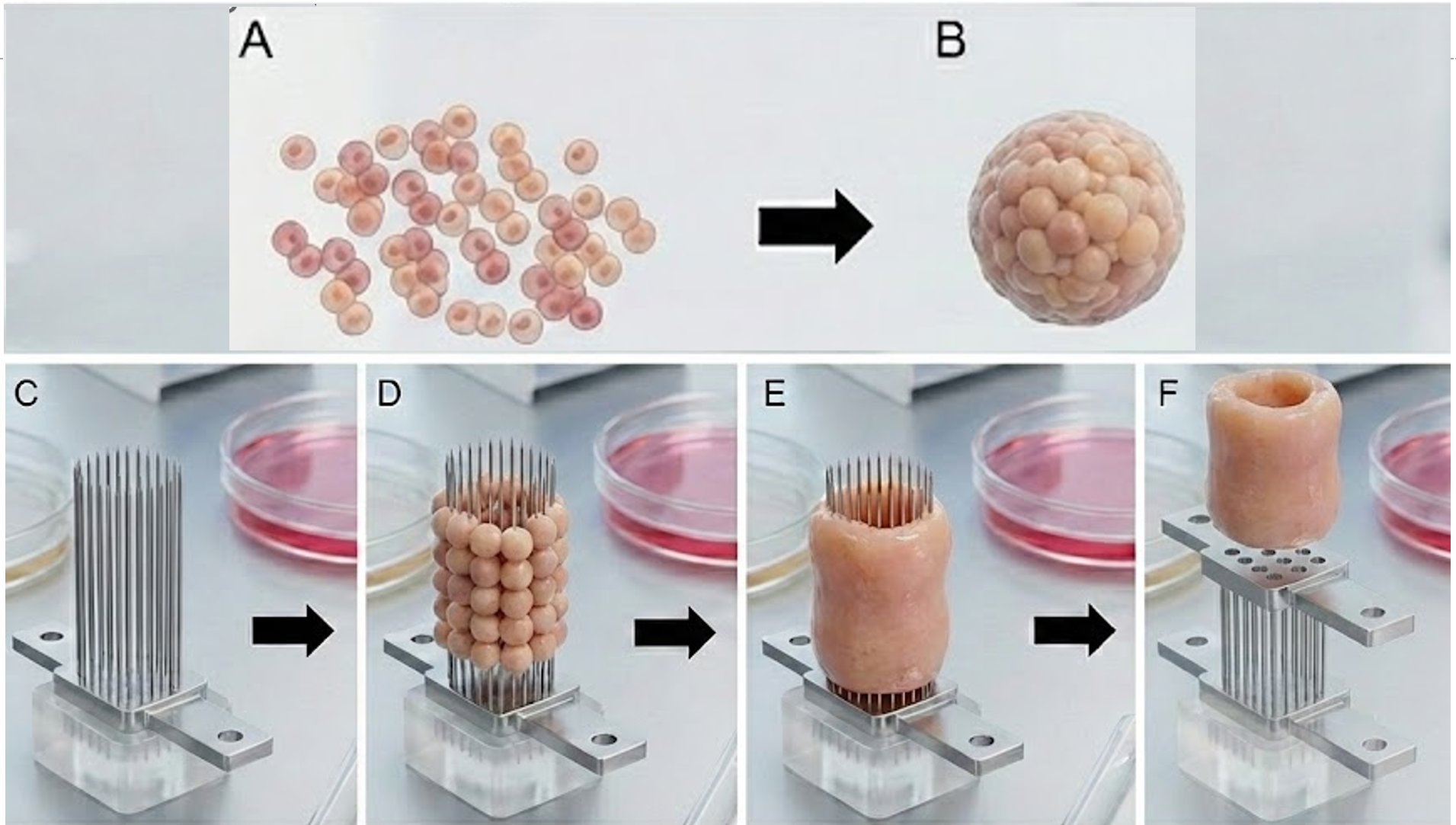
Cells are cultured into uniform multicellular spheroids — the fundamental building blocks of our constructs.
A Bio-3D printer precisely skewers spheroids onto a microneedle array (Kenzan) according to a 3D design.
Spheroids fuse spontaneously through natural cell adhesion, forming a continuous living tissue.
The fused construct is removed from the needle array — entirely scaffold-free, made only from living cells.
Externally or self-funded. Minimum 6 months (ideally 1–2 years). Send a motivation letter, CV, and names of three references to info [at] nakayama-labs.com with the subject "visiting student".
Externally or self-funded. Minimum 3-year commitment. See admission details.
Externally or self-funded. Minimum 2-year commitment. Send CV and motivation letter to info [at] nakayama-labs.com with the subject "Externally/self-funded postdoctoral fellow".
Center for Regenerative Medicine Research
Faculty of Medicine, Saga University
5-1-1 Nabeshima, Saga City
Saga 849-8501, Japan
info [at] nakayama-labs.com